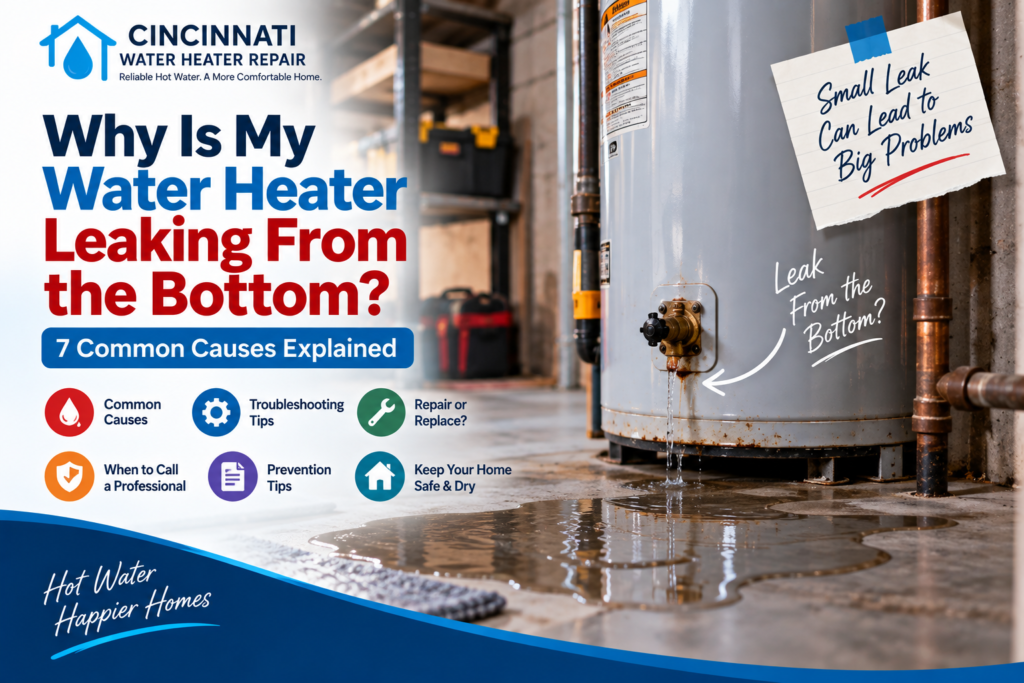
Finding your water heater leaking from bottom is unsettling, but it doesn’t automatically mean the tank itself has failed. Water pooling underneath the unit can come from several different sources — some easily repairable, others that point toward the tank body itself and generally mean replacement. The key is figuring out exactly where the water is coming from before assuming the worst.
Below, we’ll walk through the most common causes of a bottom leak, how to tell what’s actually happening, what to do right now if water is actively leaking, and how to think through repair versus replacement once you know the cause.
Why Is My Water Heater Leaking From the Bottom?
A “bottom leak” is a description of where the water ends up, not necessarily where it started. Several components sit at or near the bottom of a typical tank water heater — the drain valve, various fittings and connections, and the tank body itself — and water from any of them can run down and collect at the base of the unit, making the source harder to identify at a glance.
This distinction matters a lot for what happens next. A leaking drain valve or a loose fitting is often a straightforward, repairable fix. A leak from the tank body itself is a different situation entirely — once the steel tank has corroded through or cracked internally, it generally cannot be sealed or repaired, and replacement becomes the practical path forward. Water collecting underneath your heater does not, by itself, prove which of these is happening, which is why a closer look (or a professional inspection) is worth doing before drawing conclusions.
7 Common Causes of a Water Heater Leaking From the Bottom
1. A Leaking Drain Valve
The drain valve, located near the base of the tank, is used for flushing sediment and draining the unit. Over time, these valves can develop a slow drip due to a worn washer, a valve that wasn’t fully closed after maintenance, or mineral buildup preventing a tight seal. A leaking drain valve is one of the more common — and more repairable — causes of water appearing near the bottom of the unit.
2. A Leak From the Tank Itself
Inside every tank water heater, the steel tank is lined with glass or another protective coating to resist corrosion. Over years of use, that lining can wear down, allowing the steel underneath to rust and eventually develop a pinhole leak or crack. A leak originating from the tank body itself is not repairable in any practical sense — once the tank has failed internally, water will continue to find its way out, and the unit needs to be replaced.
3. A Loose or Leaking Connection
Cold water inlet and hot water outlet connections, along with any fittings near the top or bottom of the tank, can loosen slightly over time due to thermal expansion and contraction, or simply from age. Water from a loose fitting can run down the side of the tank and pool at the bottom, mimicking a tank leak even though the actual source is higher up. This is typically one of the more straightforward leaks to repair once identified.
4. A Temperature and Pressure Relief Valve Problem
The temperature and pressure relief (T&P) valve is a critical safety component that releases water if the tank’s internal pressure or temperature exceeds safe limits. It has a discharge pipe that typically runs down toward the floor. If the T&P valve is leaking, weeping, or discharging periodically, water can appear to be coming from the bottom of the unit when it’s actually draining down from this pipe. A leaking or malfunctioning T&P valve should be diagnosed by a professional, since it may indicate excess pressure or temperature inside the tank rather than a valve that’s simply worn out.
5. Excessive Pressure or Temperature
If the T&P valve is discharging water, it may be doing exactly what it’s designed to do — relieving dangerous pressure or temperature buildup inside the tank. This can happen due to a failed thermostat, excessive incoming water pressure, or a thermal expansion issue in a closed plumbing system. Simply replacing the valve without addressing the underlying cause can allow the same problem to recur, which is why this situation calls for a proper diagnosis rather than a quick part swap.
6. Corrosion Around the Bottom of the Tank
Visible rust or corrosion around the base of the tank, the drain valve, or nearby fittings is often a sign that moisture has been present for some time, even if the leak itself has been slow or intermittent. Corrosion can also directly weaken fittings and connections, making an existing minor leak worse over time. Corrosion tends to progress faster in areas with harder water; Cincinnati’s municipal supply, drawn from the Ohio River and the Great Miami Buried Valley Aquifer, is generally reported in the moderately hard to hard range (see Greater Cincinnati Water Works’ water quality reporting). If you notice significant rust along with active leaking, this generally points toward a unit that’s further along in its wear than a single isolated component issue.
7. Condensation or Water From Another Source
Not all water found near a water heater actually comes from the unit itself. Condensation can form on the tank during periods of high humidity or when cold water runs through pipes in a warm room, particularly with a newly filled or recently drained tank. It’s also worth checking nearby plumbing, a nearby sump pump, an HVAC condensate line, or groundwater seepage in a basement installation before concluding the water heater itself is the source.
Where Is the Water Actually Coming From?
Before assuming the worst, a careful visual inspection can often narrow things down considerably:
- Dry the area around and underneath the tank with a towel, then check back in a few hours to see where new moisture appears first.
- Check the drain valve at the base of the tank for visible dripping or moisture around the valve body.
- Inspect the top connections — the cold water inlet and hot water outlet — for moisture that may be running down the side of the tank rather than originating at the bottom.
- Look at the T&P valve and its discharge pipe for signs of dripping or recent discharge.
- Examine the tank body itself for rust streaks, bubbling, or dampness on the steel surface, which can indicate the leak is coming from the tank rather than a component.
This kind of visual inspection is something most homeowners can safely do. What you shouldn’t do is attempt to tighten fittings on a pressurized system, remove the T&P valve, or open any panel on the unit while it’s leaking — these steps can turn a manageable situation into a more serious one, and are better handled by a professional once the water and energy source have been shut off.
What to Do If Your Water Heater Is Leaking
Shut Off the Water Supply
Locate the cold water shutoff valve, typically on the pipe entering the top of the tank, and turn it off if you can safely identify and reach it. This stops new water from entering the tank and can significantly limit how much water accumulates while you arrange for repair or inspection.
Shut Off the Energy Source
For an electric water heater, if water is reaching the electrical components or you’re uncertain, shut off power at the dedicated breaker rather than attempting to work near the unit while it’s energized. For a gas water heater, follow the manufacturer’s shutoff instructions printed on the unit, and avoid manipulating the gas control valve or other gas components beyond the normal shutoff procedure. If you smell gas at any point, leave the area immediately and contact your gas utility or emergency services rather than continuing to investigate.
Protect the Surrounding Area
Move any items, boxes, or belongings away from the leak to prevent water damage, and place towels or a shallow container to catch ongoing drips if it’s safe to do so. The EPA notes that wet materials should be dried within 24–48 hours to help prevent mold growth (see the EPA’s guide to mold, moisture, and your home), so don’t leave soaked items sitting once the leak is under control. This is about limiting damage while you wait for inspection or repair, not about attempting to fix the leak yourself.
Call for Professional Inspection
Once the immediate situation is stabilized, the most reliable next step is a professional inspection to determine the actual source of the leak. Given the difficulty of distinguishing a repairable component leak from a tank-body leak without hands-on inspection, this is generally not something to diagnose with certainty on your own. Our water heater repair team can identify the source and explain your options clearly.
Can a Water Heater Leaking From the Bottom Be Repaired?
It depends entirely on the source of the leak:
- Drain valve leaks can often be repaired by replacing the valve itself, a relatively straightforward fix.
- Loose fittings or connections can typically be tightened or resealed without replacing the tank.
- A malfunctioning T&P valve may be repairable by replacing the valve, though the underlying cause of excess pressure or temperature should be identified and addressed as well.
- A leak from the tank body itself is generally not repairable. Once the internal lining has failed and the steel tank is corroding or cracked, there’s no reliable way to seal it permanently, and continuing to use the unit risks a more sudden, larger leak later.
This is exactly why identifying the actual source matters so much before deciding on a repair. A professional inspection can confirm whether you’re dealing with a fixable component issue or a tank that’s reached the end of its service life.
When a Leaking Water Heater Needs Emergency Service
Some leaking-water-heater situations call for prompt attention rather than waiting for a routine appointment:
- The leak is rapidly increasing rather than slow and steady
- Significant water has already accumulated or is spreading toward finished areas of the home
- You suspect the leak is coming from the tank body itself, which can worsen without warning
- Water is reaching electrical components on an electric water heater
- You smell gas near a gas water heater
- You’re unable to safely locate or operate the water shutoff valve
In any of these situations, it’s worth calling for emergency water heater repair rather than waiting, particularly if the unit is located above living space, near finished flooring, or in a utility closet where water damage can spread quickly.
Repair or Replace a Leaking Water Heater?
Once the source of the leak is confirmed, the decision generally comes down to a few practical considerations:
Repair may make sense when:
- The drain valve is the source of the leak
- A fitting or connection is leaking, rather than the tank itself
- The T&P valve needs replacement and the underlying cause has been identified
- The tank is otherwise in good condition, without significant corrosion
Replacement generally makes more sense when:
- The tank body itself is confirmed to be leaking
- Significant corrosion is present around the base or body of the tank
- The unit is old and showing other signs of deterioration
- Repairs have become repeated or frequent
- The tank has reasonably reached the end of its practical service life
There’s no fixed rule for exactly when repair stops making sense — it depends on the unit’s age, condition, and the nature of the leak itself. Our repair and replacement teams can walk you through what makes sense for your specific situation once the leak’s source is confirmed.
Gas vs. Electric Water Heater Leaks
The underlying causes of a bottom leak — drain valve, fittings, T&P valve, or tank body — are largely the same for both gas and electric water heaters, since both designs use a similar storage tank. The main practical difference is in how you should respond:
- Gas water heaters require care not to disturb the gas control valve or burner assembly while investigating a leak, and any suspicion of a gas smell means leaving the area immediately rather than continuing to inspect the unit.
- Electric water heaters introduce a risk if water reaches the wiring or heating element connections, which is why shutting off power at the breaker is the priority if you’re uncertain how far the leak has spread.
In both cases, the safest approach is the same: shut off water and energy, protect the surrounding area, and have a professional identify the actual source before assuming what’s needed.
What About Tankless Water Heater Leaks?
Tankless water heaters don’t have a large storage tank, so a “bottom leak” isn’t really the right framework for diagnosing a leak on these systems. Instead, leaks on a tankless unit are more likely to come from fitting connections, the internal heat exchanger, condensate drainage (on condensing models), or isolation valves used for maintenance and descaling. Because the internal components and typical leak points are different from a conventional tank, a tankless leak shouldn’t be diagnosed using the same assumptions covered above. If your tankless system is leaking, our tankless water heater repair team can identify the actual source and address it directly.
How to Prevent Water Heater Leaks
While not every leak is preventable, regular maintenance meaningfully reduces the risk of an unexpected one:
- Schedule routine maintenance, including periodic flushing to manage sediment, which can contribute to corrosion over time if left unaddressed.
- Check the anode rod periodically, since a depleted anode rod leaves the tank’s steel lining more exposed to corrosion.
- Test the T&P valve occasionally to confirm it’s functioning correctly rather than stuck or slowly weeping.
- Inspect fittings and connections during routine maintenance visits, tightening or resealing anything that’s begun to loosen.
- Pay attention to the unit’s age, since the risk of an internal tank leak increases meaningfully as a water heater approaches the end of its typical service life.
Our water heater maintenance service covers these checks on a regular schedule, which is generally the most effective way to catch a developing leak before it becomes a larger problem.
Frequently Asked Questions
Why Is My Water Heater Leaking From Bottom?
Common causes include a leaking drain valve, a loose fitting or connection, a T&P valve issue, corrosion, or in more serious cases, a leak from the tank body itself.
Can a leaking water heater be repaired?
It depends on the source. Leaks from the drain valve, fittings, or the T&P valve are often repairable. A leak from the tank body itself generally isn’t.
Does a bottom leak mean I need a new water heater?
Not necessarily. Many bottom leaks come from a repairable component rather than the tank itself, which is why identifying the actual source matters before assuming replacement is needed.
Can a water heater drain valve leak?
Yes, drain valves can develop leaks due to a worn washer, mineral buildup, or a valve that wasn’t fully closed after use. This is one of the more common and more repairable causes of a bottom leak.
What should I do if my water heater is leaking?
Shut off the cold water supply if you can safely reach it, shut off the electricity or follow the gas unit’s shutoff instructions, protect the surrounding area, and have a professional inspect the unit to confirm the actual source.
Is a leaking water heater an emergency?
It can be, particularly if the leak is increasing rapidly, water is reaching electrical components, you smell gas, or you can’t safely shut off the water supply. In these cases, emergency service is worth calling right away.
How do I know if the tank itself is leaking?
Signs include moisture or rust directly on the steel tank body, rather than isolated to a valve or fitting, and a leak that persists or worsens even after other components have been checked. A professional inspection is the most reliable way to confirm this.
How long can a leaking water heater last?
This varies significantly depending on the cause. A leaking component like a drain valve or fitting can often be repaired without affecting the unit’s remaining service life, while a leak from the tank body itself typically signals that replacement is needed relatively soon.
Final Takeaway
Water heater leaking from bottom is a situation worth taking seriously, but it isn’t automatically a sign your tank needs to be replaced. Drain valves, fittings, and the T&P valve are all common, often-repairable sources of a bottom leak, while a true tank-body leak is the situation that generally calls for replacement. If your Cincinnati-area water heater is leaking, our water heater repair team can identify exactly where the water is coming from, our emergency water heater repair service is available for leaks that can’t wait, and our water heater replacement team can help if your tank has reached the end of its service life.