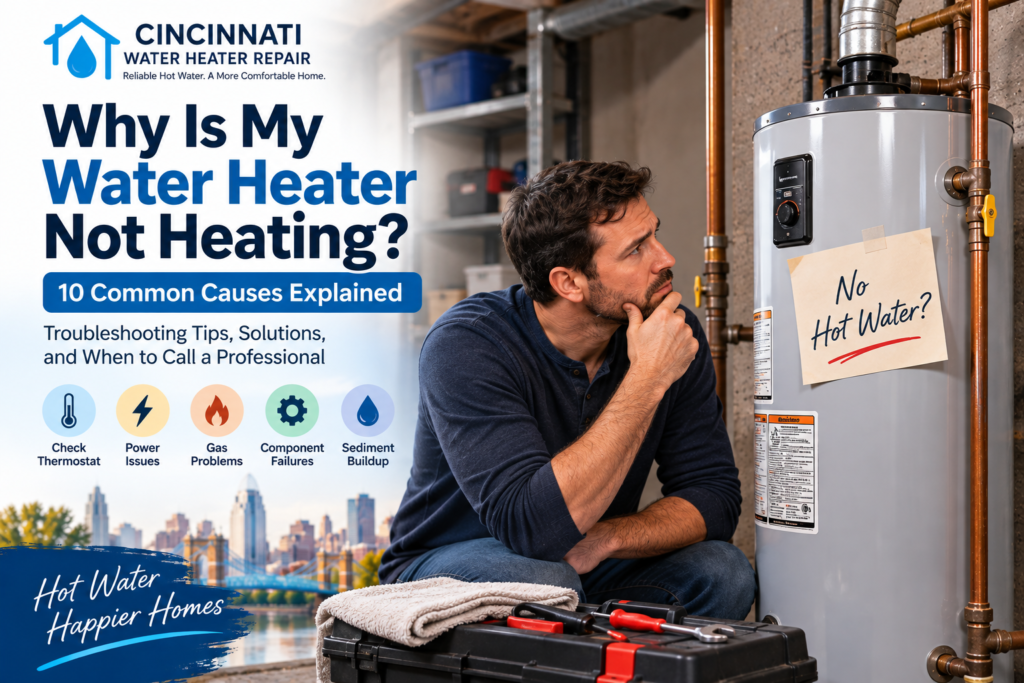
A water heater not heating is one of the most common — and most disruptive — problems a homeowner can run into. Sometimes it’s something simple, like a tripped breaker or a pilot light that’s gone out. Other times it points to a failed heating element, a bad thermocouple, or a tank that’s simply reached the end of its useful life.
Below, we’ll walk through the 10 most common reasons a water heater stops heating, what you can safely check yourself, how gas and electric units differ, and how to decide whether repair or replacement makes more sense for your situation.
Why Is My Water Heater Not Heating?
In most cases, a water heater that isn’t heating falls into one of a few categories: a power or gas supply interruption, a failed internal component (thermostat, heating element, thermocouple, or gas control valve), or sediment buildup that’s interfering with normal operation. The right fix depends entirely on which of these is actually happening, which is why troubleshooting in order — starting with the simplest, safest checks — makes sense before assuming the worst.
It’s also worth distinguishing between a water heater producing no hot water at all and one producing water that’s noticeably cooler than usual. A complete lack of hot water often points to a power, gas, or ignition issue. Gradually declining hot water output more often points to sediment, a partially failed heating element, or a unit that’s struggling to keep up with household demand.
10 Common Reasons a Water Heater Isn’t Heating
1. The Thermostat Is Set Too Low
It sounds obvious, but a thermostat that’s been accidentally bumped, or one that was set low to save energy and forgotten, is a genuinely common cause of lukewarm or cool water. Most manufacturers and the U.S. Department of Energy point to around 120°F as a reasonable setting that balances comfortable hot water with reduced standby energy loss (see the Department of Energy’s home energy checklist). If your thermostat is set significantly lower than that and your household is running out of hot water quickly, this is worth checking first.
2. The Circuit Breaker Has Tripped
Electric water heaters run on a dedicated circuit, and if that breaker trips, the unit stops heating entirely — even though the rest of the house may have power. A tripped breaker can be a one-time fluke, but a breaker that trips repeatedly usually signals an underlying electrical problem, such as a failing heating element drawing excess current, and shouldn’t simply be reset over and over.
3. A Heating Element Has Failed
Most electric water heaters have two heating elements — an upper and a lower. If the upper element fails, you may get little to no hot water at all. If only the lower element fails, you might still get a limited amount of hot water before it runs out quickly, since the upper element can partially heat the top portion of the tank. Heating elements are a common wear item and are usually replaceable without needing a full tank replacement, though this typically involves working inside an electrical junction and is best left to a licensed technician.
4. The Pilot Light Is Out
On standard gas water heaters, a pilot light that’s gone out will stop the burner from igniting, leaving you with no hot water. Drafts, a dirty thermocouple, or a minor gas supply interruption can all cause a pilot to go out. Many gas water heaters have a straightforward relighting process printed directly on the unit — follow those instructions exactly, and never attempt to light a gas appliance if you smell gas.
5. The Gas Supply Is Interrupted
A closed gas shutoff valve, a tripped gas safety device, or a broader supply interruption can prevent a gas water heater from igniting at all, even with a working pilot and thermocouple. If other gas appliances in your home are also affected, the issue may be upstream of the water heater itself, and your gas utility can help confirm whether supply has been interrupted.
6. The Thermocouple or Flame Sensor Has a Problem
The thermocouple is a small safety device that senses whether the pilot flame is lit. If it’s dirty, misaligned, or worn out, it can cause the gas valve to shut off the pilot flame even when everything else is working correctly — a safety feature that can be frustrating when the actual pilot is fine. This is a common, relatively inexpensive repair, but it does involve gas components and is generally best handled by a professional.
7. Sediment Has Built Up Inside the Tank
Minerals in the water supply settle at the bottom of the tank over time, forming a layer of sediment. In severe cases, this layer can insulate the burner or heating element from the water above it, significantly reducing heating efficiency and, in extreme cases, contributing to a unit that struggles to heat water at all. Regular water heater maintenance, including periodic flushing, helps keep sediment from reaching this point.
8. The Gas Control Valve Has Failed
The gas control valve regulates gas flow to the burner and pilot. When it fails, the unit may not ignite at all, even with a working pilot and thermocouple. Gas control valves are sealed units that aren’t typically repaired piece by piece — a failed valve usually means the whole valve assembly needs replacement, which is a job for a licensed technician given the gas components involved.
9. The Water Heater Is Overloaded by Demand
Sometimes a water heater isn’t malfunctioning at all — it’s simply undersized for how much hot water the household is using at once. Running the dishwasher, washing machine, and a shower simultaneously can outpace even a properly functioning tank’s recovery rate, especially in colder months when incoming water temperature is lower and the unit has to work harder to reach the same output temperature.
10. The Water Heater Has Reached the End of Its Useful Life
Tank water heaters have a limited service life, and internal corrosion, mineral buildup, and general wear accumulate over the years. An older unit that’s heating inconsistently, showing rust in the water, or has needed multiple repairs recently may simply be at the point where replacement makes more sense than continuing to chase individual component failures.
Water Heater Not Heating: Gas vs. Electric Problems
Gas and electric water heaters fail differently, since they rely on entirely different systems to generate heat. Understanding which category your unit falls into can help you narrow down the likely cause before calling for repair.
| Electric Water Heater Not Heating | Gas Water Heater Not Heating |
|---|---|
| Tripped breaker or blown fuse | Pilot light has gone out |
| Failed upper or lower heating element | Faulty thermocouple or flame sensor |
| Faulty thermostat | Gas supply interruption |
| High-temperature limit switch tripped (often due to overheating) | Failed gas control valve |
| Wiring or electrical connection issue | Blocked burner or venting issue |
Electric Water Heater
Electric units are generally simpler mechanically, but their failures are almost always electrical in nature, meaning any hands-on diagnosis beyond checking the breaker should involve a professional. Electric water heaters also have a high-temperature limit switch (sometimes called a “high-limit” or “ECO” switch) that can trip and cut power to the heating elements if the unit overheats — a safety feature that sometimes needs to be manually reset by a technician once the underlying cause is addressed.
Gas Water Heater
Gas units introduce more components into the ignition process — a pilot, thermocouple, and gas control valve all have to work together correctly. This means there are more individual points of failure, but also that many gas water heater issues are diagnosable by checking each component in sequence, which is exactly the kind of systematic troubleshooting a qualified technician performs during a service call.
What Can You Safely Check Yourself?
Before assuming the worst, there are a few safe checks most homeowners can perform:
- Check the thermostat setting to confirm it hasn’t been accidentally lowered.
- Check the breaker panel for an electric water heater to see if the dedicated breaker has tripped, and reset it once if so.
- Check the pilot light on a gas water heater to see if it’s lit, following the relighting instructions on the unit if it’s out.
- Look for obvious leaks around the base of the tank or its connections, which can sometimes accompany a heating problem.
- Listen for unusual noises, such as popping or rumbling, which can point toward sediment buildup as a contributing factor.
- Check for error codes if you have a newer unit or tankless system with a digital display, and reference the manufacturer’s documentation for what the code indicates.
These checks are low-risk and can often identify the problem, or at least rule out the simplest causes, before you need to call for service. What you should not do is attempt to open a gas control valve, work inside an electrical junction box, or disassemble a heating element yourself — these involve real safety risks and are best left to a licensed professional.
When a Water Heater Needs Professional Repair
It’s time to call a professional when:
- A reset breaker trips again shortly after being reset
- The pilot light won’t stay lit after a proper relighting attempt
- You smell gas at any point — stop immediately and contact your gas utility or a licensed professional rather than continuing to troubleshoot
- The water heater is leaking in addition to not heating
- You’ve checked the basics above and the unit still isn’t heating properly
- You’re not comfortable working around gas components or electrical panels
Our water heater repair team can diagnose which of these components is actually responsible and address it directly, rather than guessing based on symptoms alone.
Can Sediment Cause a Water Heater to Stop Heating?
Yes, though it’s usually a gradual contributor rather than a sudden, complete cause. As sediment accumulates at the bottom of a tank, it insulates the burner or lower heating element from the water above it, reducing how efficiently heat transfers into the tank. Over time, this can mean longer recovery times, reduced hot water output, and in more severe cases, a unit that struggles to reach the set temperature at all.
Sediment buildup is influenced by water hardness, so homes on harder water — including much of the water supplied across the Cincinnati area — are more likely to see sediment become a contributing factor over time if the tank hasn’t been flushed regularly. Routine water heater maintenance, including periodic flushing, is the standard way to keep this from becoming a significant issue.
Should You Repair or Replace a Water Heater?
Once you know what’s actually causing the problem, the repair-versus-replace decision usually comes down to a few practical factors:
Repair generally makes sense when:
- The unit is relatively new and otherwise in good condition
- The problem is an isolated component failure, such as a thermocouple, heating element, or thermostat
- There’s no sign of tank corrosion or leaking from the tank body itself
Replacement generally makes more sense when:
- The tank is older and nearing or past its typical service life
- There’s active leaking from the tank body rather than a fitting or valve
- The unit has needed multiple significant repairs recently
- Visible corrosion or rust in the water suggests the tank itself is deteriorating internally
There’s no universal dollar threshold that applies to every situation, since repair costs, unit age, and remaining expected service life all factor in differently for each household. If you’re unsure which category your water heater falls into, our repair and replacement teams can assess the unit directly and walk you through the tradeoffs for your specific situation.
What About Tankless Water Heaters?
Tankless water heaters heat water on demand rather than storing it, which means they fail differently than conventional tank units when they stop producing hot water. Common causes for a tankless system not heating include:
- Scale buildup inside the heat exchanger, which restricts flow and reduces heating efficiency — more likely in areas with harder water if the unit hasn’t been descaled on schedule
- Flow sensor issues, where the unit fails to detect sufficient water flow to trigger ignition
- Ignition problems on gas tankless models, similar in concept to a standard gas unit but involving different components
- Error codes, which most tankless units display on a control panel or remote display and which correspond to specific diagnostic information in the manufacturer’s documentation
- Gas supply or electrical/control issues, which can prevent the unit from powering on or igniting at all
Because tankless systems rely on more electronic controls than a standard tank unit, and because the exact meaning of an error code varies by manufacturer and model, it’s worth checking your unit’s manufacturer documentation before assuming the cause. If you’re seeing an error code or the unit isn’t producing hot water at all, our tankless water heater repair team can diagnose it directly.
How to Prevent Water Heater Heating Problems
While not every failure is preventable, a few habits meaningfully reduce how often a water heater runs into heating problems:
- Flush the tank periodically to manage sediment buildup before it starts affecting efficiency.
- Test the temperature and pressure relief valve occasionally to confirm it’s functioning and not stuck.
- Check the anode rod during routine maintenance, since a depleted anode rod leaves the tank lining less protected over time.
- Keep the area around the unit clear, especially for gas water heaters, which need adequate airflow for proper combustion.
- Schedule routine professional maintenance, which can catch a failing thermocouple, a weakening heating element, or early sediment buildup before it causes a complete loss of hot water.
A consistent maintenance routine is generally the most effective way to avoid an unexpected “no hot water” situation. Our water heater maintenance service covers these checks on a regular schedule.
Frequently Asked Questions
Why is my water heater not heating?
The most common causes include a tripped breaker, a pilot light that’s gone out, a failed heating element or thermocouple, an interrupted gas supply, or sediment buildup reducing heating efficiency.
Why is my electric water heater not heating?
Electric water heaters most often stop heating due to a tripped breaker, a failed upper or lower heating element, a faulty thermostat, or a tripped high-temperature limit switch.
Why is my gas water heater not heating?
Gas water heaters commonly stop heating because the pilot light has gone out, the thermocouple has failed, the gas supply has been interrupted, or the gas control valve itself has failed.
What should I check if my water heater has no hot water?
Start by checking the thermostat setting, the breaker (for electric units), and the pilot light (for gas units). If those basics check out, the issue likely involves an internal component that needs professional diagnosis.
Can a bad thermostat cause no hot water?
Yes. A malfunctioning thermostat can either fail to signal the heating element or burner to activate, or it may be set (or have drifted) to a temperature too low to notice a difference from cold water.
Can sediment stop a water heater from heating?
Sediment buildup can significantly reduce heating efficiency and, in more severe cases, contribute to a unit struggling to heat water adequately, though it’s usually a gradual factor rather than a sudden complete failure on its own.
Is it worth repairing an older water heater?
It depends on the unit’s age, the specific failure, and its overall condition. An isolated component failure on an otherwise sound tank is often worth repairing, while a unit with tank corrosion or a history of repeated failures usually isn’t.
When should I replace my water heater?
Replacement generally makes sense when the tank is leaking from the tank body itself, shows internal corrosion, has needed multiple significant repairs, or is old enough that continued repairs no longer make practical sense compared to a new unit.
Final Takeaway
A water heater not heating almost always traces back to one of a handful of causes — a power or gas interruption, a failed internal component, or sediment that’s built up over time. Some of these are simple to check yourself, while others involve gas or electrical components that call for a licensed technician. If your water heater in the Cincinnati area still isn’t heating after checking the basics, or if you’re weighing whether repair or replacement makes more sense for your situation, our water heater repair and water heater replacement teams can diagnose the issue and get your hot water back on track.